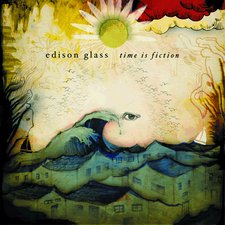

Second albums are always difficult to navigate for a band. Either keep close to the safe, familiar, and expected or experiment and delve into uncharted musical territory, hoping the audience is intrigued enough to follow. Edison Glass finally returns with their second wide-release LP, Time is Fiction. I am pleased to say that the good ship Glass manages to deftly avoid the dreaded 'sophomore slump' altogether. The route chosen is exploration and advancement of their craft… with just a dash of the past for flavor.
The established sound is at once familiar- Edison Glass' indie sensibilities forming the frame of the layered artwork of each song. But the frame has solidified in a way that only bands who've played together for years can achieve. Cascading and converging guitar riffs, grinding bass lines, and a fascinating variety of drum fills all serve to achieve a musical aesthetic too involving to give a cursory glance to. These are songs to be savored because, despite their accessibility and instantly compelling nature, there is a depth that a mere glance won't reveal. Xylophone, strings, and I still haven't been able to pick out everything else filling the palette. If there is such a thing, this is classic, refined Edison- complete with Joshua Silverberg's pleasant reluctance to sing his melodies exactly the same way twice, and James Usher's absolute mastery of the hammer-on. And it's on that very characteristic that Time is Fiction begins.
The energy is matched only by the staggering composition, as the instantly catchy "Let Go" opens the record. Other familiar tracks from last year's EP are present, including "All Our Memories," and my favorite of the upbeat- "Cold Condition." Fans will be instantly pleased with both the former's thick forest of ever-unveiling sound, and the latter's riotous sing-a-long choral melody. The album's turn to the serious and explorative is equally memorable. "Chances" incorporates a folk-jazz feel, while "Jean Val Jean" gently and deliberately sways its way through a wide variety of understated tone. The feel of the later tracks becomes increasingly pensive and anticipatory and the sense is deliberate, as the lyrical theme orbits almost exclusively around introspection and the awareness that there is more beneath the surface.
The poetic songwriting is most evident in "Jean Val Jean," with its personalization of the character from "Les Miserables." "It's a battle between just and good / What you know is right / What you know you should / Will good overcome religion? / It's a battle between grace and pride… Will grace overcome what was done?" The only real tragedy of the album is "Children in the Streets," having a valiant message regarding poverty and hunger with a sound more similar to prior albums than its surrounding tracks, but lyrically... There's just so oddly blunt a presentation of the subject matter that it stands in completely obvious contrast to the eloquence the rest of the songs deliver. One unfortunate blight upon an otherwise amazing album shouldn't dissuade anyone from loving Time is Fiction, which is nothing short of a truly great and masterful continuation of Edison Glass' already stellar career.
- Review date: 1/31/08, written by David Goodman
 |
 |
 Record Label: Credential Recordings
Album length: 12 tracks: 43 minutes, 31 seconds
Street Date: February 5, 2008
Buy It: Amazon.com
Record Label: Credential Recordings
Album length: 12 tracks: 43 minutes, 31 seconds
Street Date: February 5, 2008
Buy It: Amazon.com
|  |
  |


 Pastor Mike Jr., Deitrick Haddon, Anthony Brown, Bri Babineaux Team for I GOT AWAY Tour Pastor Mike Jr., Deitrick Haddon, Anthony Brown, Bri Babineaux Team for I GOT AWAY TourThu, 25 Apr 2024 15:00:00 EST |
| iNTELLECT and Mitch Darrell Release Latest Collaborative Single, "Limitless" Thu, 25 Apr 2024 03:10:00 EST |
| Metalcore Newcomers Heal the Hurt Launch with Crushing Debut Single, "Withering" Thu, 25 Apr 2024 00:10:00 EST |
| TimFM has a new Morning show in Bethany, MO, and Lincoln, NE Wed, 24 Apr 2024 15:10:00 EST |
| Gospel Legend Vanessa Bell Armstrong Readies for 1st Album in Over a Decade Wed, 24 Apr 2024 15:00:00 EST |
| Elevation Nights '24 With Elevation Worship And Pastor Steven Furtick Returns This Fall Wed, 24 Apr 2024 11:10:00 EST |
| Freedom Heart Releases "Dreaming with You" to Christian Radio Wed, 24 Apr 2024 10:50:00 EST |
Click here All News Headlines |  RSS
RSS

| DAD TIRED FOUNDER JERRAD LOPES EXPANDS POPULAR MINISTRY WITH DEBUT CHILDREN’S TITLE Wed, 10 Apr 2024 17:07:46 +0000 |
| “Anything Goes” by Andrew Kerhoulas of Brother K Thu, 04 Apr 2024 02:54:00 +0000 |
| Demi-Leigh Tebow to release debut book this August Mon, 18 Mar 2024 21:20:38 +0000 |
Click here All JFH Blog Posts | RSS




 Mack Brock Time and Time Again - EP [Centricity]