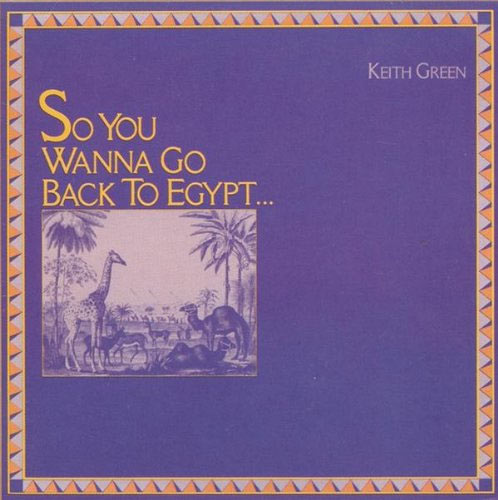

For his third album, So You Wanna Go Back to Egypt, Keith Green took an unorthodox approach: he did not force anyone to pay for the LP. Listeners could give him a donation if they wanted, but he decided that, just as salvation is a free gift from God, that the message should be available for free through his music as well -- even if it meant going to the lengths of mortgaging his house to make the record. Green's perspective and message live on in these ten songs decades later.
A real treat that easily could have a review of its own opens the album, the title track. Green always had a great sense of humor, but it shines through on this song arguably better than any other moment in his career. He reflects on the Israelites wandering in the desert and their desire to give up the freedom that God graciously gave them and return to Egypt. From the sounds of livestock that begin the song, to the fantastic lyrical images—take the lines “Eating leaks and onions by the Nile / Ooh, what breath for dining-out in style” or the creative Numbers 16 reference “Well, we once complained for something new to munch / The ground opened up and had some of us for lunch” for example—the track perfectly transports the listener into the wilderness with the Israelites. As the song concludes, Green even finds a way to give a menu of manna-centered foods, such as fillet of manna and ba-manna bread. One would struggle to think of a more fun, biblically-focused, and artistic way to begin the album; it showcases Green at his creative peak.
Even with the great strength of the opener, the album does not lose steam. “Pledge My Head to Heaven” comes next and features quite the special guest in Bob Dylan on the harmonica. It also serves as Green's dedication to put God before everything else in his life, even what he found dearest on Earth: “I pledge my son, I pledge my wife, I pledge my head to heaven, for the gospel.” Nowhere is Scripture more front and center on an already Scripture-loaded album than “If You Love The Lord,” an offering easy to sing along to that declares the identity and calling of those who place their trust in Jesus: “We are His workmanship, created for good works in Christ. / He calls us to offer up ourselves a living sacrifice.” This catchy chorus often lingers in my mind, and I am thankful to keep meditating on these words hours after I hear the song play.
The album's two extremes from a tempo perspective, “Romans VII” and “Lies,” round out side A of the record. The first discusses—just as the biblical chapter does—how we often fail to live the life in Christ we want to as Green's piano playing takes center stage. In contrast, “Lies,” the most upbeat tune on the album, fulfills Keith's requirement of having a song on each of his albums about the devil. Green warns believers of the deception the devil tries to speak: “That wolf can look so good especially dressed in the right clothes, the wooly clothes / And as he starts to knit the counterfeit he'll totally make you feel like you're paralyzed / He'll keep you spun around and looking down / Just when you should be looking straight to the skies.” While people know Keith Green best for his brilliant piano playing, this track in particular highlights how So You Wanna Go Back to Egypt incorporates additional instrumentation much more than his first two releases. No Compromise has some guitar, but the guitar found on the title track, or “Lies”, would feel out of place on that album or his debut. Here, it fits in perfectly.
“I Want to be More Like Jesus” and “Oh Lord, You're Beautiful,” the biggest worship songs, come on the second half of the album and manage to feel both simple and profound. The lyrics ring true for Christians in all stages of their journey in the Way, where Green sings “I want to, I need to, be more like Jesus” or “Oh Lord, You're beautiful / Your face is all I seek / For when Your eyes are on this child / Your grace abounds to me.” Established artists like Josh Garrels, who follows in Green's footsteps and gives away his music for free, and Chris Tomlin have covered “Oh Lord, You're Beautiful,” and some churches still sing the tune on occasion. Such examples highlight the way that Keith Green's music and words have stood the test of time.
The chastising lyrics of “You Love the World” contrast with the song's lighthearted music, but perhaps this decision, which seems odd on the surface, carries a greater significance. In the same manner that Green calls out believers for living their lives as if everything is fine without prioritizing God, the music almost embodies that happy yet erroneous perspective some people carry while the words call for change. A thoughtful choice on Green's part, the song becomes more memorable and meaningful than it would have been if the passionate pianist had made the tune more somber sounding.
While awfully close to a five-star album, a few tracks on So You Wanna Go Back to Egypt do not reach the same height as the others. Though not necessarily filler, “Unless the Lord Builds the House” nicely takes biblical language from Psalm 127, but lacks the musical punch to go along with it. “Romans VII,” another track with beautiful lyrics, is less memorable musically than other songs present. Though far from major detriments, these elements are enough to bring this release down from a full five-star ranking.
Still, the album may save the best for last in “Grace By Which I Stand.” Throughout his career, Green frequently discussed the importance of wholehearted devotion to Jesus, and although he did not ignore God's grace, people often remember him better for his emphasis on the former topic. Within that context, as well as following up “You Love the World” in the track sequence, the focus on grace to conclude this record is especially beautiful. The song acknowledges our weakness (“I vowed to serve You / When it was brand new / But like Peter, I can't even watch and pray / One hour with You / And I bet I could deny You, too”), while highlighting the undeserved forgiveness God extends to us in spite of it (“But nothing lasts / Except the grace of God / By which I stand in Jesus”). Keith's powerful vocal performance of those words sends this listener away praising God for the overwhelming goodness with which He showers us.
So You Wanna Go Back to Egypt may not quite receive the title of Green's magnum opus—that likely goes to his nearly flawless debut—but it still displays why Keith Green remains one of the most influential and important figures within the history of Christian music. This album convicts, encourages, entertains, and invites the listener to dig into their faith at a deeper level. It is that last point Keith would have desired above all else; he never wanted the music to be about him, but about drawing people near to God. So You Wanna Go Back to Egypt perfectly accomplishes that, and it has the ability to continue doing so for years and generations to come.


 Jason Lovins Band Opens Historic New Chapter with Stowtown Records Jason Lovins Band Opens Historic New Chapter with Stowtown RecordsTue, 27 Oct 2026 14:30:12 EST |
| Lakelin Lemmings Drops Powerful Music Video for "I Ain't For Everybody" Mon, 26 Oct 2026 16:59:53 EST |
| Vince Gill Wins Inaugural Legacy Songwriter Icon Award from NMPA Mon, 26 Oct 2026 14:03:51 EST |
| Koryn Hawthorne Talks Faith and Healing, Prepares New EP for 2027 Mon, 26 Oct 2026 13:31:44 EST |
| Tecola Campbell Makes Her Debut with "Only You Can Deliver" Sun, 25 Oct 2026 16:48:29 EST |
| Ronnie Martin Announces New Record, Out January 29, 2027 Sat, 24 Oct 2026 15:41:23 EST |
| We The Kingdom Releases New Part of Three-Project Musical Journey Fri, 23 Oct 2026 16:27:07 EST |
Click here for All News Headlines |  RSS
RSS




 Beach Chapel A Special Place In Heaven (independent)